How it works
Know before you apply.
Judjit helps enterprise IT candidates catch the blocker before they waste the time. Start with the quick web verdict, save one evidence-backed profile, then move the same judgment flow onto supported job boards with the extension.
Illustrative example — not a real candidate.
Every wrong application costs more than you think.
Hours spent tailoring for a role you were never going to win
False confidence from surface keyword overlap
Good roles skipped because the real blocker was never named
Why Judjit exists
To tell you whether to apply, prepare, or skip before a weak-fit application turns into wasted time.
The layers that actually decide whether a role is viable.
Judjit checks what determines whether the role is worth your time, not just whether some words overlap.
Decision output
Fit score, main blocker, strongest evidence, and the clearest next move.
Role family
Whether the job is truly in your lane: enterprise apps, delivery, platform, PMO, QA, support, or adjacent IT scope.
Seniority and scope
Whether the job expects architecture ownership, people leadership, programme scope, or hands-on delivery depth beyond your evidence.
Environment fit
Platforms, delivery model, languages, location, and team context that change whether a strong profile is actually viable.
Hard blockers
Requirements that make the role a genuine no-go now: missing platform proof, authorization constraints, location mismatch, or experience gaps.
Clear enough to act on.
One role gets ruled out fast. Another earns real follow-up. The point is a sharper decision.
Principal CRM Platform Architect · Paris · Hybrid
Main blocker
The role requires architecture ownership across multi-country enterprise programmes. Your profile shows strong delivery leadership, not platform architecture authority.
Illustrative example — not a real candidate.
Enterprise Service Delivery Lead · Paris · SaaS transformation
Strong match
Stakeholder management, cross-functional delivery, and enterprise change work align well. Integration depth is the one gap to frame honestly.
Illustrative example — not a real candidate.
What it looks like in practice.
The profile you build once. The workspace where every verdict lands.
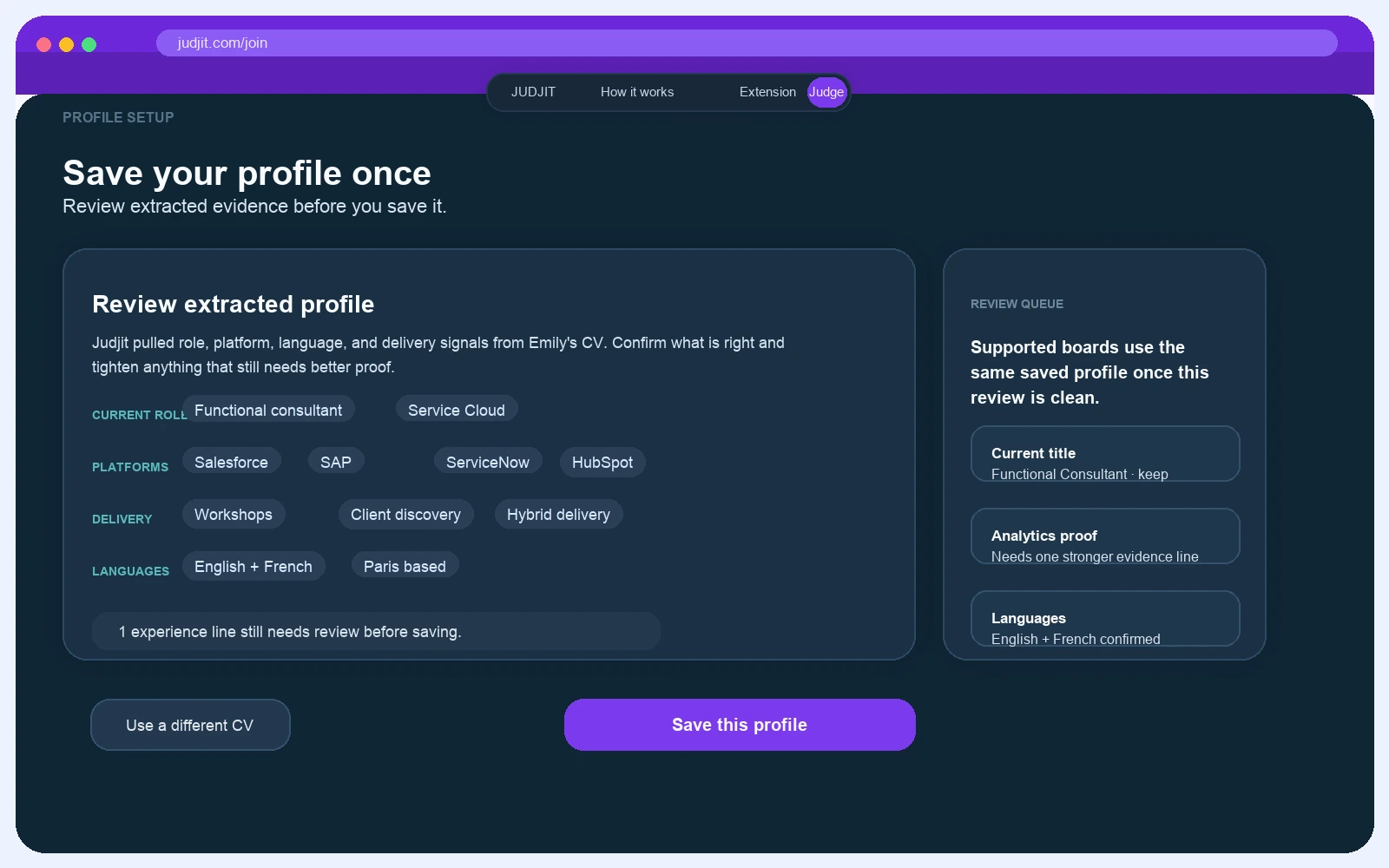
Profile setup
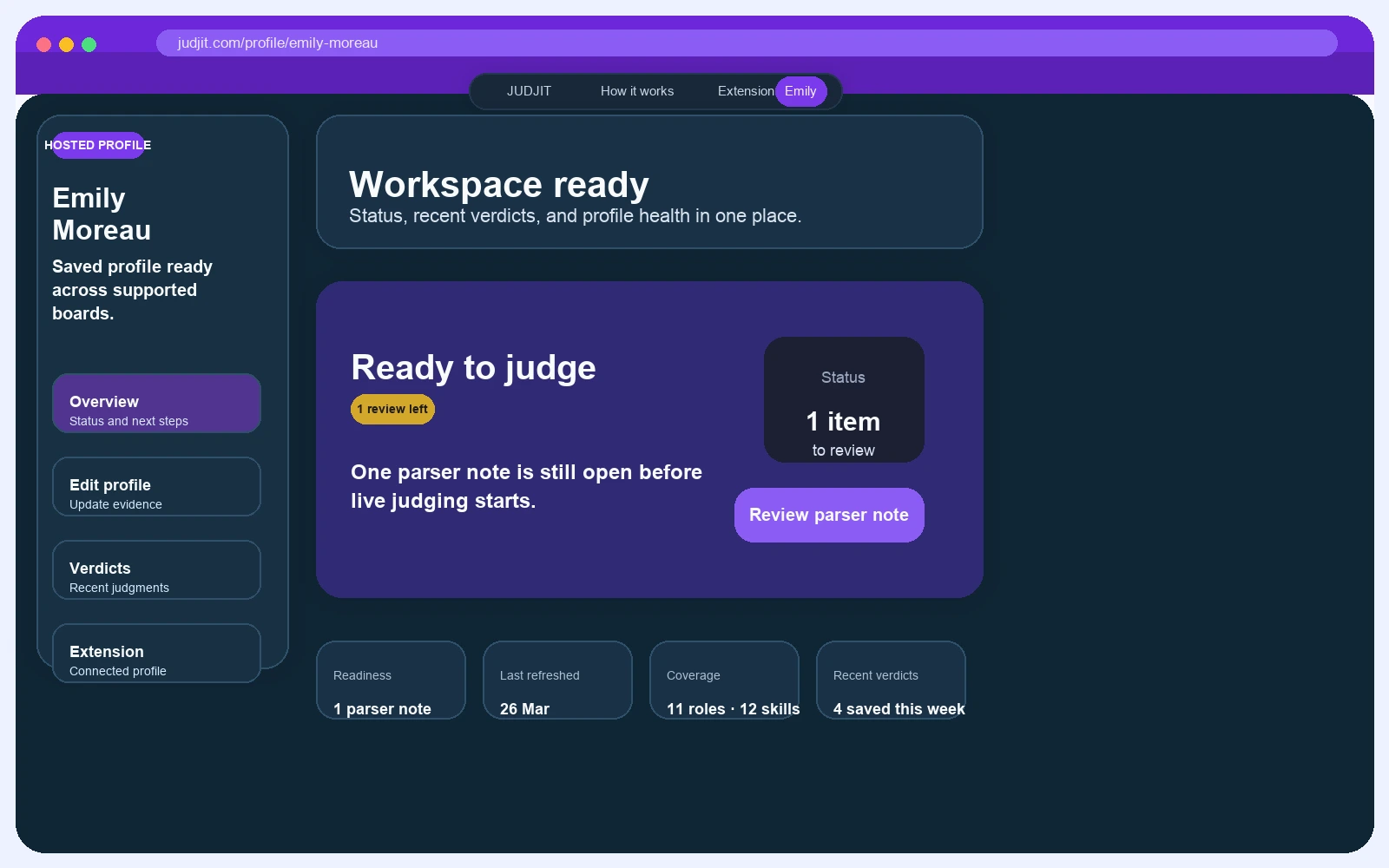
Profile workspace
Start on the web. Bring it onto live boards when it earns it.
Start with the public demo
Paste a job description into the web demo and get a fast read on fit, blocker, and whether the role deserves more effort.
Best when you want to test the logic before you save anything.
Save one profile with real evidence
Upload or paste your CV once, review the extracted profile, and keep the same evidence available across devices and future verdicts.
This is what powers the sharper extension judgment later.
Judge roles live in the extension
On supported boards, Judjit opens the verdict beside the role you are reading so you can decide without leaving the page.
Use Judge this job on standard pages or Judge selected text when the board needs a manual read.
Straight answers.
Do I need an account for the demo?
No. The web demo is the fastest way to see Judjit's verdict style before you save a profile or install the extension.
Why save a profile if the demo already works?
The demo proves the decision model. A saved profile gives Judjit durable evidence from your CV so every future verdict can be faster, more consistent, and available in the extension.
What changes in the extension?
The extension brings the verdict next to the role on supported boards. You stay on the listing, trigger the read, and see score, blocker, fit dimensions, and next move in place.
How is this different from a keyword match?
Judjit weighs scope, seniority, delivery context, and hard blockers instead of rewarding surface overlap that may not survive a real screening conversation.

Try the verdict on the web. Save your profile when you want it everywhere.
The public demo is the fastest entry point. The saved profile and extension are what turn that verdict into a repeatable job-selection workflow.